In this article
- Two legal routes for a French-Moroccan couple
- The religion requirement: check it first
- Marrying in Morocco: CCAM, adouls and transcription
- Marrying in France first, then celebrating in Marrakech
- Timeline: when to start what
- The ceremony in Marrakech: bringing two families together
- The reception: venues, guests and budget
- Planning your French-Moroccan wedding with AMÉLIE
- FAQ
A French-Moroccan couple has two ways to marry legally: at a town hall (mairie) in France, or before adouls, Morocco's marriage notaries, once the French partner has a certificate of capacity to marry (CCAM) from the French consulate. Either way, the big celebration can happen in Marrakech. Which route fits you depends on each partner's religion, the country you live in and how much time you have before the date.
We have planned weddings in Marrakech since 2022. On the first call, mixed couples almost always ask us the same things: which papers, what kind of ceremony, and how to throw one party for two families. We take them here in that order.
Two legal routes for a French-Moroccan couple
When one partner is French and the other Moroccan, a marriage can be recognised in two ways. You marry in France before the mayor. Or you marry in Morocco before the local authorities, then have the certificate transcribed into the French civil register.
A wedding before French authorities in Morocco is not open to you. The French consulates in Morocco reserve it for couples where both partners are French. Service-Public, the French government's information site, adds that when one partner also holds the nationality of the country where the wedding takes place, the couple must go through a local authority. A French citizen who is also Moroccan therefore marries before the adouls.
| Town hall in France, party in Marrakech | Adoul marriage in Morocco | |
|---|---|---|
| Who officiates | The mayor or a deputy, at the town hall | Adouls, in Morocco |
| French step | Banns posted for 10 days, interview with the registrar | CCAM from the relevant French consulate, at least 3 months |
| Moroccan step | Copy of the certificate filed with the Moroccan consulate | Family judge's authorisation for a mixed marriage |
| Recognition in France | Immediate, it is a French certificate | Transcription in Nantes, by post |
| Religion requirement | None among the conditions Service-Public lists | Yes, under Moroccan law |
| Ceremony in Marrakech | Symbolic, entirely your own | Can sit alongside the adoul marriage |
If you can't decide, the timeline often settles it. We can talk it through on a 30-minute introduction call: tell us where you stand, and we'll work out with you how the paperwork and the celebration fit together.
The religion requirement: check it first
Religion matters for a marriage in Morocco. The French consulates in Morocco state that one or both partners must be Muslim, and that one or both must live in the country or the town where the wedding takes place.
The legal guide published by the Hassan II Foundation for Moroccans Living Abroad goes further. A Muslim Moroccan woman can only validly marry a Muslim man, and a Muslim man can marry a Jewish or Christian woman. Where someone converts, a document proving conversion to Islam goes into the file. UK government guidance describes the same rule for British nationals: the man must be Muslim or convert, and the woman must be Christian, Jewish or Muslim.
Two examples make it concrete.
Claire, French and Christian, marries Youssef, Moroccan and Muslim. The religion requirement is met, so an adoul marriage is possible, subject to the CCAM and the judge's authorisation.
Yasmine, Moroccan and Muslim, marries Thomas, French and not Muslim. In Morocco, the marriage requires Thomas to convert. If he doesn't, the French town hall is the legal route and Marrakech hosts a symbolic ceremony.
These rules touch on faith and family, and we don't give legal advice. Only the adoul, the French consulate and the Moroccan consulate can confirm your situation.
Marrying in Morocco: CCAM, adouls and transcription
The adoul route suits couples who want a Moroccan marriage certificate and a ceremony in Morocco in the same trip. It needs lead time and a clean file.
1. The CCAM from the French consulate
The French partner applies for a certificate of capacity to marry (certificat de capacité à mariage) at the consulate general covering the place of the adoul marriage. For Marrakech, that is the French Consulate General in Marrakech. According to the French consulates in Morocco and Service-Public:
- both partners attend the appointment, their presence is mandatory, and the Casablanca consulate gives one appointment per couple;
- the file follows your district's checklist, and some consulates send back any incomplete file;
- banns are posted for 10 days, at the consulate or at the town hall where you live in France;
- an interview is possible, together or separately, to check that the marriage complies with French law;
- the wait is at least 3 months from the day the complete file is filed, and the consulate asks couples not to chase it before then.
2. The judge's authorisation and the adouls
The Moroccan partner contacts the adoul where they live. For a mixed marriage in Morocco, the Hassan II Foundation's guide describes an application to the family judge at the court of first instance. The public prosecutor runs an inquiry into the foreign spouse. The file includes, among other items, a birth certificate extract, a certificate of capacity to marry and a criminal record certificate.
If you want a prenuptial agreement, the French consulates in Morocco point out that a notary draws it up, not an adoul, and it has to be ready before the ceremony.
3. Transcription in Nantes
Once married in Morocco, you ask for the certificate to be transcribed into the French civil register. For Morocco, the request goes by post only, to the Transcription Department of the Central Civil Registry (Service central d'état civil) in Nantes.
Service-Public calls transcription recommended rather than mandatory. Without it, though, the marriage only takes effect between the spouses and towards their children: the foreign spouse cannot get a French residence permit, and the couple cannot claim married-couple tax benefits. If the conditions are not met, the public prosecutor can oppose transcription within 2 months.
Transcription also gets you a French family record book (livret de famille). For a spouse visa, the French consulates in Morocco require a certified copy of the transcribed marriage certificate.
Marrying in France first, then celebrating in Marrakech
This is the simplest route when you live in France, and the only one when the religion requirement is not met. You sign at the town hall, then fly to Marrakech to celebrate with both families.
At the French town hall
According to Service-Public, one of you needs a lasting link with the town: your home or residence, or a parent's. Residence means at least one month of continuous living there by the date the banns are posted.
The Moroccan partner usually provides:
- ID and proof of address;
- a full birth certificate extract showing parentage, no more than 6 months old if born abroad;
- sworn translations of foreign documents, sometimes with an apostille or legalisation depending on the country;
- a certificate of custom (certificat de coutume), and a certificate of single status (certificat de célibat) when their country cannot supply up-to-date documents.
Banns are posted for 10 days. The registrar interviews you both together, with some exceptions. The wedding must then take place within the following year.
One rule shapes your Marrakech weekend: in France, a religious wedding may not be held before the civil one. The town hall comes first.
On the Moroccan side
Moroccan family law lets Moroccans abroad marry under the formalities of their host country. The Hassan II Foundation's guide lists the conditions that still apply: consent, legal capacity, a wali (guardian) where needed, no legal impediment, no waiver of the dowry, and two Muslim witnesses.
The same guide asks couples to file a copy of the marriage certificate with the Moroccan consulate within three months. It carries no date, so ask your consulate for its current list.
Timeline: when to start what
Administrative waits stack on top of planning time.
For an adoul marriage, file the CCAM at least 3 months before the date, plus the time it takes to gather documents and get an appointment. The judge's authorisation on the Moroccan side comes on top.
For a town hall wedding, allow at least 10 days of banns after you file. The town hall date can come a few days or several months before Marrakech.
For the Marrakech celebration, we recommend contacting us at least 12 to 18 months ahead for the busiest seasons. So run the celebration and the paperwork side by side: an incomplete CCAM file can come back to you, and the venue you want may not wait.
The ceremony in Marrakech: bringing two families together
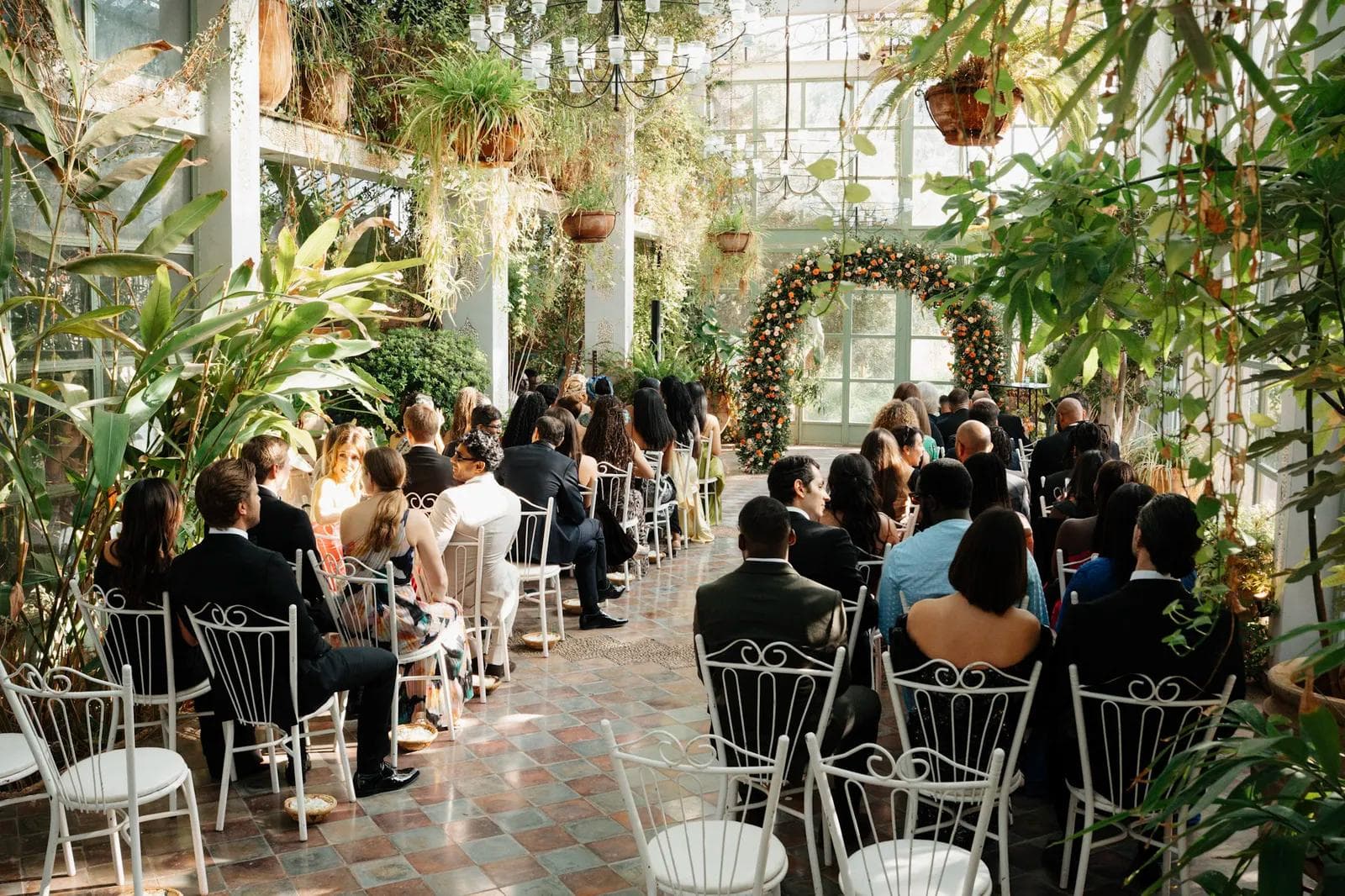
Once the legal side is settled, the Marrakech ceremony is yours. A symbolic ceremony has no legal value, but you choose the officiant, the language, the readings and the running order.
For a French-Moroccan couple, the questions that matter often go beyond paperwork.
Language comes first. Some guests speak French, others Arabic or Darija. You can switch between languages during the ceremony, or print translated programmes.
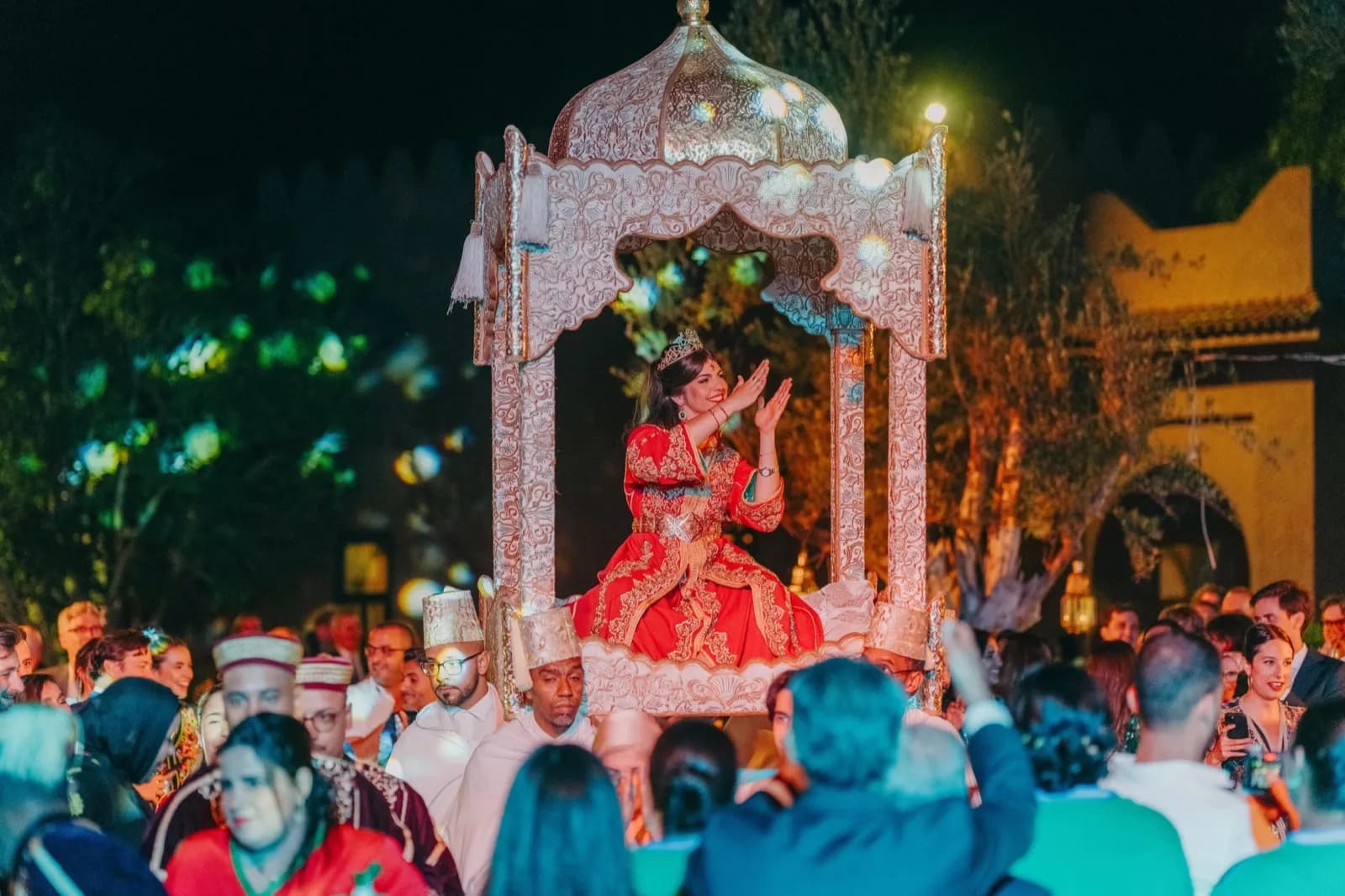
Then, who speaks: someone close from each family, a celebrant, or both. On rituals, you can bring in one tradition from each side, or keep the ceremony simple and save traditions for the evening.
That leaves the question of one day or two. A separate evening before the wedding day needs deciding early, because it changes the venue, the budget and the number of hotel nights. Our work is to turn those choices into a programme both families can follow without getting lost.
The reception: venues, guests and budget
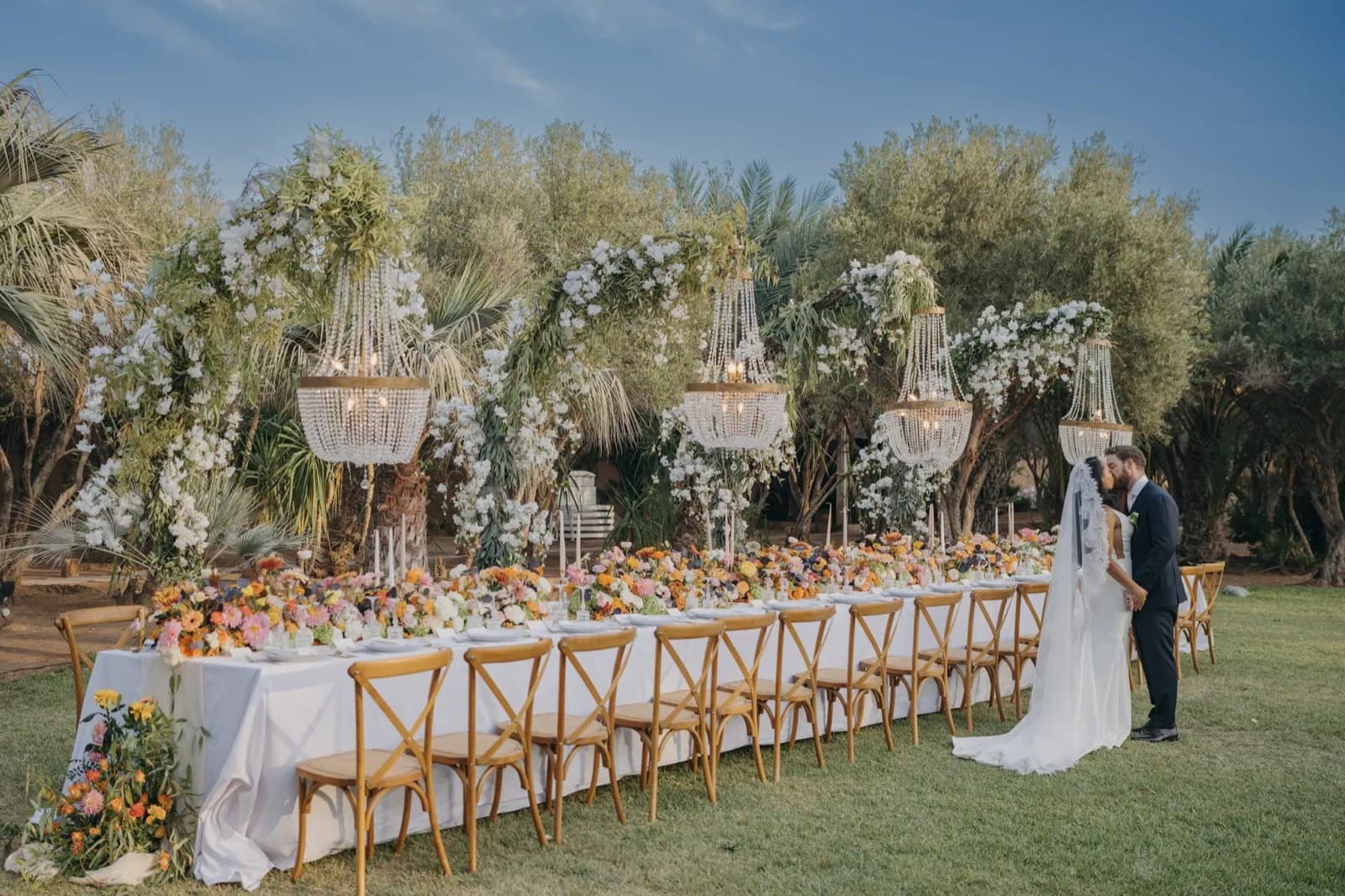
Riads, palace gardens or the Agafay desert: each setting suits a different guest count and style. Our guide to Marrakech wedding venues and our riad, palace or desert comparison help you choose.
For a mixed couple, logistics matter as much as decor. Some guests fly in from France, others may already live in Morocco. We coordinate transfers to and from Marrakech Menara airport, and guest accommodation.
Raise the menu early too: Moroccan, French or both, and how alcohol fits with your families. Our guide to local wedding caterers in Marrakech gives you a feel for the options.
On budget, most of the weddings we plan fall between €30,000 and €200,000, and we recommend keeping 10 to 15% aside for the unexpected. Our planning fees are explained in how much a wedding planner costs in Marrakech.
Planning your French-Moroccan wedding with AMÉLIE
You don't need to travel to Marrakech before the wedding. Venue visits, supplier meetings and tastings happen by video, with photos and samples sent afterwards, and you follow everything from our online client space.
Here is how we work together:
- A 30-minute introduction call about your two families, your date and the legal route you have in mind.
- Creative direction: venue, style and programme.
- Monthly coordination up to the wedding.
- Wedding week, with our team on site from the Monday.
We take no commissions and no kickbacks from suppliers, and we reply within 48 hours. For the paperwork, we point you to the right offices and build the celebration around your administrative timeline.
FAQ
Is a French-Moroccan marriage held in Morocco valid in France?
It takes full effect in France once the Central Civil Registry in Nantes has transcribed it. Until then it does not count for third parties: no residence permit for the foreign spouse and no married-couple tax benefits.
Do I have to convert to marry a Moroccan?
For a marriage in Morocco, it depends on who is Muslim. According to the Hassan II Foundation's guide, a Muslim Moroccan woman can only marry a Muslim man, while a Muslim man can marry a Jewish or Christian woman. For a French town hall wedding, Service-Public lists no religion requirement.
Can we marry at the French consulate in Marrakech?
Not if one of you holds Moroccan nationality. That wedding requires two French partners, and a French-Moroccan dual national has to go through the local authority.
How long does the CCAM take?
At least 3 months from the day the complete file is filed, according to the French consulates in Morocco, plus the time needed to gather documents and get an appointment.
Can we have a religious ceremony in Marrakech after the town hall?
Yes. French law forbids a religious wedding before the civil one. Once you are married at the town hall, you can hold the ceremony of your choice in Marrakech.
If the non-Moroccan partner is British or American rather than French, the rules differ: our legal guide to getting married in Morocco covers them nationality by nationality. Rules change, so always check with the adoul, the French consulate and the Moroccan consulate before you book.
Amélie
Wedding planner based in Marrakech, helping couples create their dream day with Moroccan soul and refined elegance.