In this article
- What happens at a traditional Moroccan wedding?
- The henna night: where the celebration starts
- The negafa: who she is and what she does
- The amariya: the bride's entrance
- The caftan: what the bride, the couple and the guests wear
- The food, and what to tell your guests
- Music: Andalusian, chaabi and Gnawa
- Religious and civil ceremony: what the traditions don't do
- Planning Moroccan traditions into a Marrakech wedding
- FAQ
- Ready to plan yours?
Moroccan wedding traditions come as a sequence of moments: a henna night, several changes of caftan run by a negafa, and the bride's entrance on the amariya. You don't have to be Moroccan to include them. You do need to know what each one is, who runs it and what it asks of your guests, because that is what decides whether a ritual feels honoured or borrowed.
This guide covers the three traditions that matter most when a foreign or mixed couple plans a Moroccan-style wedding, then the caftan, the food and the music. It draws on a real henna night from our journal and lists the decisions to make before you build a Marrakech wedding around them.
What happens at a traditional Moroccan wedding?
A traditional Moroccan wedding runs over several stages. A 2021 study of Moroccan weddings in the Revue européenne des migrations internationales lists them: the engagement, the henna, the hammam, the wedding itself and the sbou'hi, a meal the morning after. Each stage has its dances, songs, music and banquet (Affaya, REMI, 2021).
A foreign couple doesn't have to hold all of them. Keep the ones that mean something to your families and build the weekend around those. That usually comes down to one day or two. If you want a henna night, decide early, because it needs its own venue, its own music and its own guest list.
When one of you is Moroccan, the traditions also carry family expectations. Talk them through with both families before anything is booked. Our guide to the French-Moroccan wedding in Marrakech covers how couples balance both sides on the day.
The henna night: where the celebration starts
The henna night opens the wedding. In the same REMI study, it marks the first day of the ceremony, the guests are mostly women, and women and girls have their hands decorated with henna. Henna is associated with fertility, prosperity and luck (Affaya, REMI, 2021).
UNESCO recognises it as heritage. In 2024 it inscribed "Henna: rituals, aesthetic and social practices" on its Representative List of the Intangible Cultural Heritage of Humanity, from a joint file by 16 states including Morocco, the UAE, Egypt and Saudi Arabia. UNESCO describes henna as "a symbol of joy" used in everyday life and at festive occasions such as births and weddings, and says families pass it on through observation and hands-on practice (UNESCO).
A real henna night: Claire and Youssef
Claire is from Lyon, Youssef from Casablanca. Their wedding at Selman Marrakech began with a henna night hosted by Youssef's family:
- 80 guests in a private villa
- live Andalusian music
- a neggafa who dressed Claire in four different caftans through the night
- henna designs by two master artists
- platters of Moroccan pastries, dried fruit and mint tea passed round all evening
The henna night venue and catering came to €3,500. The wedding day itself had 180 guests, so the henna night was the smaller family evening, where Youssef's family hosted and Claire's side discovered the tradition with them.
Bringing in guests who have never been to one
Tell your guests what the evening is before they arrive. A line on the invitation or the wedding website does it: what a henna night is, that it's a party and they're welcome to have their hands decorated. Guests who know what to expect join in. The ones who don't tend to hover at the edge.
The negafa: who she is and what she does
The negafa (also spelled neggafa) is the traditional bridal dresser. She dresses the bride, manages her outfit changes through the evening and makes sure the customs are respected. The REMI study describes her double role in Morocco: guardian of tradition, and the person who sells and rents the objects that go with the couple through their ceremony (Affaya, REMI, 2021).
So a negafa often brings more than her hands. She can supply the caftans and the amariya, along with her team. At Claire and Youssef's henna night, the neggafa handled all four caftan changes.
Two questions for a foreign bride before booking one:
- How many outfits? Settle the number of changes and on which evenings. Four in one night, as Claire did, means four stretches away from your guests.
- Rent or buy? Ask what the offer includes: her presence, the outfits, the amariya and its bearers. The answer changes the budget.
The amariya: the bride's entrance
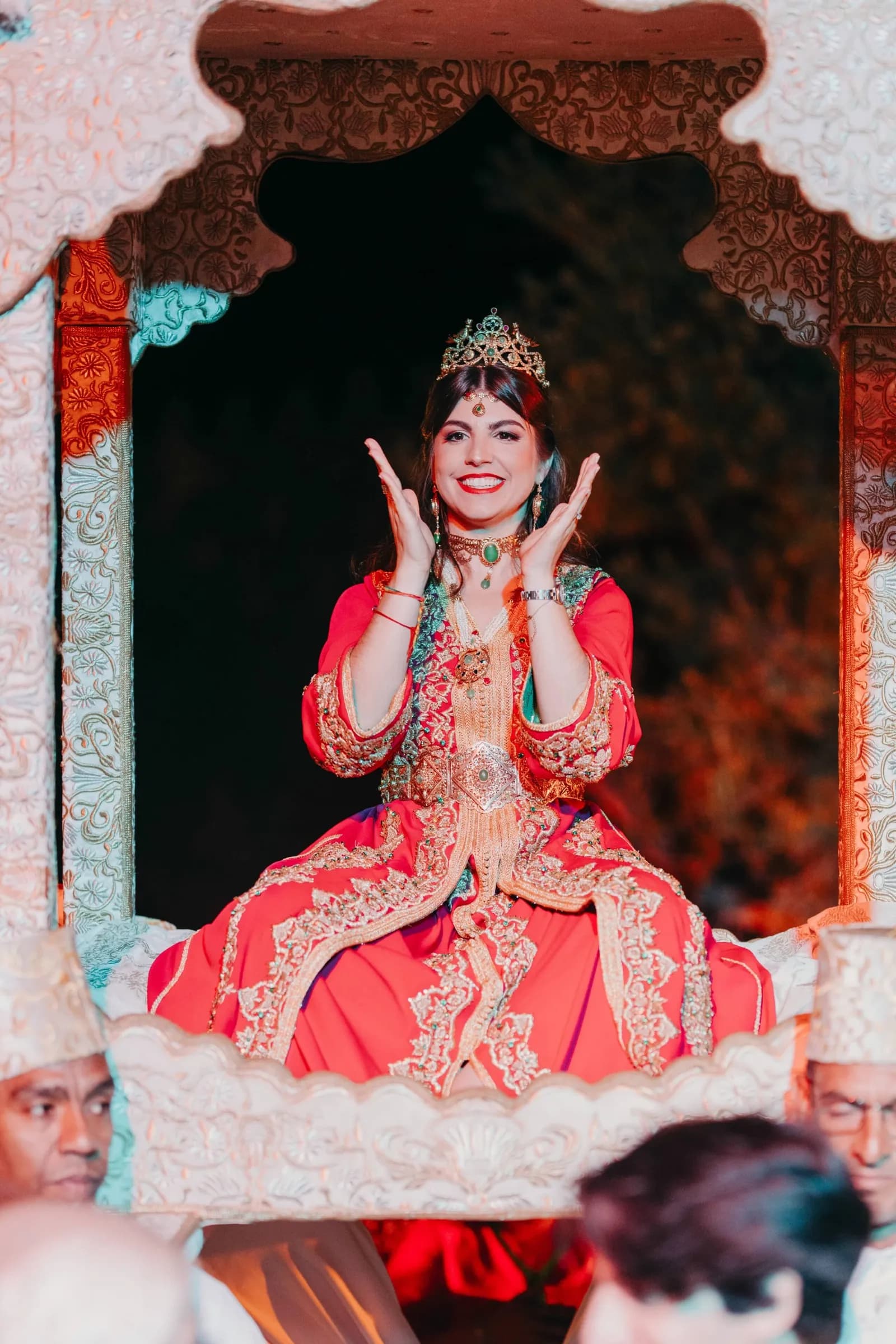
The amariya is a palanquin decorated with regional craft traditions, on which the bride makes her entrance. The REMI study notes it is often carried by four men or women from the negafa's team, or by members of the couple's families (Affaya, REMI, 2021). You'll also see it spelled amaria or ammaria.
Before you plan it, look at the venue. The amariya needs room to come in, turn and set down, and a riad courtyard is a very different stage from a palace garden. Then decide who carries it: family carrying the bride is a strong gesture, and if the family isn't there, the negafa's team does it. Last, choose whether the entrance happens at the henna night or at the main reception, and tell your photographer and band.
The caftan: what the bride, the couple and the guests wear
The Moroccan caftan joined UNESCO's Representative List of the Intangible Cultural Heritage of Humanity in 2025. UNESCO describes it as a long tunic worn by people of all genders and ages on special occasions, including weddings, baptisms and festivals. Weavers make its fabrics, tailors shape it, and other artisans make its buttons, braids and embroidery (UNESCO).
Women wear embroidered caftans through the stages of a Moroccan wedding, and a green caftan embroidered in gold is generally worn on the henna day (Affaya, REMI, 2021). For a foreign bride, that gives a simple rule: a caftan for the henna night, the dress of your choice for the ceremony. Claire wore four caftans at her henna night and a Pronovias gown the next day.
Guests can wear a caftan too. Since everyone wears one to celebrate, inviting your guests to put one on for the henna night is a welcome gesture, and nobody will read it as fancy dress.
The food, and what to tell your guests
The table is the easiest place to mix two cultures. Your guests taste Moroccan food without needing to know a single ritual.
At Claire and Youssef's wedding at the Selman, every course paired France with Morocco:
- Cocktail hour: Moroccan mezze next to a raw bar, a sushi station and Veuve Clicquot.
- Dinner: five seated courses from the Selman's culinary team, including rack of lamb with chermoula.
- Dessert: guests chose between tarte tatin and a traditional Moroccan pastilla au lait.
- The cake: six tiers with sugar roses and gold leaf, made jointly by a French patissier and a Moroccan pastry chef.
- The henna night the evening before: platters of Moroccan pastries, dried fruit and mint tea, passed round all night.
The idea is easy to copy: put one Moroccan dish in each course. Guests new to Morocco find familiar flavours on the plate, and the Moroccan family finds its own cooking.
For your guests, one practical thing matters most: tell them what to wear. On the wedding website, say evening by evening whether a caftan is welcome (see the caftan section above) and what suits the ceremony. A guest from abroad won't always feel able to ask.
Music: Andalusian, chaabi and Gnawa
The music changes with the moment. Claire and Youssef had live Andalusian music at the henna night. At the wedding, a 10-piece band played French chanson, Moroccan chaabi and international pop, and a Gnawa set took over at midnight.
Gnawa has been on UNESCO's list since 2019. UNESCO describes it as "first and foremost a Sufi brotherhood music", with roots going back at least to the 16th century and a place today in Morocco's national identity (UNESCO). A Gnawa set brings a spiritual tradition into your party, so tell the musicians which moment you want it for.
Religious and civil ceremony: what the traditions don't do
Henna, the negafa and the amariya belong to the celebration. They don't make you legally married. For a legal marriage, it is generally simplest to marry civilly in your home country and hold the celebration in Morocco.
You can still have a ceremony that reflects both cultures. At Claire and Youssef's wedding, a French officiant and a Moroccan imam led the ceremony together, with readings and vows in both languages. For the legal side by nationality, read our guide to getting married in Morocco as a foreigner.
Planning Moroccan traditions into a Marrakech wedding
These traditions involve a lot of people, each working their own way: a negafa and her team, henna artists, musicians, a villa or riad for the henna night, a caterer. Families sometimes know a few of them. A foreign couple usually knows none.
A planner pulls them together. AMÉLIE has planned 120+ weddings, with a team based in Marrakech since 2022 that works in French, English and Arabic. Full service means we take care of it from the first call to the last dance: the venue, the design, the vendors. The negafa, the henna artists, the musicians and the caterer are among those vendors.
Still deciding which traditions to keep? Book a 30-minute introduction call. We'll talk through your families, your guest list and the evenings you have in mind. To see how other couples did it, browse our real weddings.
For peak season (March to May, and October to November), we recommend getting in touch 12 to 18 months before your date. A henna night adds a second venue and a second set of vendors to book.
FAQ
Can a non-Moroccan couple have a henna night?
Yes. UNESCO describes henna as a symbol of joy used at weddings, and the henna night is the party that opens the wedding. When one partner is Moroccan, that side of the family often hosts it, as Youssef's family did for Claire.
What is the difference between a negafa and a wedding planner?
The negafa dresses the bride, manages her outfit changes, keeps the customs and often rents out the caftans and the amariya. A wedding planner runs the whole wedding: venue, design, vendors and timing. At a Moroccan-style wedding, the negafa is one of the vendors the planner books and coordinates.
Who carries the amariya?
Often four men or women from the negafa's team, or members of the couple's families, according to the 2021 REMI study.
What food is served at a Moroccan wedding?
At Claire and Youssef's wedding in Marrakech, guests had Moroccan mezze at cocktail hour, rack of lamb with chermoula at dinner and a choice of traditional pastilla au lait or tarte tatin for dessert. The cake was made jointly by a French patissier and a Moroccan pastry chef. At the henna night, Moroccan pastries, dried fruit and mint tea were passed round all evening.
What should guests wear to a Moroccan henna night?
A caftan is welcome: UNESCO describes it as worn by people of all genders and ages at celebrations. Let guests know ahead so they can plan their outfit.
Is a traditional Moroccan ceremony legally binding for foreigners?
No. The henna night, the negafa and the amariya belong to the celebration. For a legal marriage, it is generally simplest to marry civilly at home and celebrate in Morocco.
Ready to plan yours?
Each tradition works best when it has a reason to be there, like a family that wants to host the henna night or a bride who has pictured her amariya entrance. Book your 30-minute introduction call and tell us which ones matter to you, or start with our real weddings in Marrakech.
Amélie
Wedding planner based in Marrakech, helping couples create their dream day with Moroccan soul and refined elegance.